Showing posts with label Kerr Center. Show all posts

Sunday, July 14, 2013

13JUL14

Greetings from Baker Heritage Farms;

Finally, a (somewhat) normal week. For Donald it was back to work at his regular jobs and for Debbie it was time to run errands, and take care of the house. For the kids, it was essentially a normal, summer week.

Debbie attended her Beginning Farmers and Ranchers class at Kerr Center for Sustainable Agriculture Saturday. As always, she enjoyed the class, interacting with the other attendees and the great instructors. It was a long class, going from 9 am to 6 pm. She got some good ideas from the introductions, which is always a good sign. Class covered insecticides, insect pest management, plant diseases, and post harvest handling of crops, as well as business planning, learning that it is better to make mistakes on paper, though they will happen in real life (something Debbie is already very much aware of) and business management. They also learned to research and document assumptions, and that you need to include budgeting for education, as well as other items, when pricing products. They covered pesticide (organic, of course) safety handling and personal protective equipment (PPE). Pesticide is used as an umbrella term for such items as herbicides, insecticides, and fungicides, as "cide" means "to kill". Also discussed were the new OSHA standards for Material Safety Data Sheets (MSDS), which will be called Safety Data Sheets in the future, and will include universal symbols. Debbie also learned that there are different characteristics between fruits and vegetables that need to be considered during the harvest period, being reminded that they are all alive during the process. It was interesting to learn that you do not mix fruits and vegetables in storage. After classroom instruction and discussion, demonstrations were conducted, including PPE, different types of sprayers and nozzles. She was tired and happy when she finally got home.

Also on Saturday, Donald expanded the chicken pen to give the chickens more room as well as more opportunity to graze growing grass. We are quickly running out of backyard. He also cleaned under the hen house, a chore that we try to do at least every other week. The droppings all go into a compost pile.

New Chicken Pen Expansion
For cost savings and ease of installation and relocation, Snow (or construction) fence material was used. The chickens will only be allowed to graze in this area certain times and/or days, and will not be in the area when there is no one to watch over them. We hope that this will stop some of the escapes and provide better living conditions.

We now have a new dilemma. Some of our hens are "pen-hopping". We have at least one hen that flies out of the main pen and, after grazing on the loose for a little while, flies into the breeding pen. She may end up getting stuck in the breeding pen as we may replace one of the ones in the breeding pen with her.

Our turkeys are becoming quite comfortable roosting in the trees. One night Danielle and Adam counted 10 turkeys in the trees.

How Many Turkeys in the Tree?
You will probably need to get your magnifying glass out, but can you count how many turkeys are in the tree? They have become like college students, trying to see how many people fit into a telephone booth, only they are trying to see how many turkeys can stay on one branch.

We are happy to report that our work on our ReThinking Baker Heritage Farms plan seems to be having a positive affect on our personal and farm lives. We now understand that we cannot do everything at once and have reduced our stress levels substantially. We are finally enjoying the farm and appreciating it much more. Our current goal is to revisit our time resources allocations due to Donald adding a new part-time career and our need to begin thinking about our long-term retirement plans (no, we are not thinking about retiring from the farm, the farm will be our retirement plan, as well as a new and hopefully productive church life).

Update: Posted this blog before we included some important news - one of our hens laid the first Baker Heritage Farm egg - the Incredible, Inedible, Egg. Yes, Danielle found the first egg in the hen house on Saturday. It was small and broken, but it was a good sign.

FIRST EGG
For now,

Blessings to all from:

Baker Heritage Farms

"The righteous will inherit the land and dwell in it forever." Psalm 37:29

Monday, April 29, 2013

13APR29

Greetings from Baker Heritage Farms:

Sometimes the problems you run into are out of your control. For instance, this is a late update as we had an internet outage, something that was out of our control.

What is within our control, however, is the way we manage our time, and we have not been doing so good at managing our time this year. Hopefully we will be able to work on improving that over the next several months.

Due to off-farm commitments, we did not have the opportunity to do anything this past week, and we will be crunched for time over the next two months. Not a good time to be crunched for time if you want to be a farmer.

Note to all future backyard and small acreage farmers - try to plan your time so that you are able to dedicate the necessary amount to your farming operations during critical phases, including land preparation, seed planning and ordering, planting, and harvesting. Weather does not always cooperate (as we have learned over the past two years) and you need to be prepared to get out into the fields as soon as weather permits, or you can lose a whole season. Fortunately, we are still in our infant stages and are planning to be diversified enough to always have productive work to do.

Donald checked the seedlings yesterday and found that they were growing well, but still a little weak to be planted. In our case, that is good, as we still need to till the plots where they will be planted.

Debbie attended a Composting class yesterday at the Kerr Center, an extra class for her Beginning Farmer and Rancher program. Donald attended last year and Debbie said that she now has a better understanding of what he was talking about when he returned from his class. The purpose of this class is to learn approaches to building soil fertility for sustainable marketing farming, with a focus on compost, vermicompost (worms), compost tea, the soil food web, microbial innoculants, biochar, and discussions on cover crops, green manures, and organic systems.

Debbie enjoyed the class and found that it was very informative, interesting, and fun with good speakers that provided good information and gave her some good ideas for Baker Heritage Farms. She had a chance to meet others during the class and exchange information as well.

One of the areas we plan to concentrate on this year under our ReThinking Baker Heritage Farms will be to expand our composting operations with the hope of becoming more professional so that we can generate more compost material.

This week our concentration will be on preparing the brooders for the Turkeys, which are expected to arrive in about two weeks. We need to sanitize the tubs, get the warming lights reset, and prepare the tubs for their new occupants.

We will also be working on our compost as well as visiting the production fields (now that the sun is out) to see what damage has been done and what we need to do to get them in operation. We will be reviewing the seed we have on hand to see if any can still be planted (if not, we will store until they can) as well as preparing ground for some miscellaneous seed (such as our gourds and herbs).

In addition, we have to work on our ReThinking Baker Heritage Farms plan, as this will also fulfill Debbie's upcoming homework assignment.

It is "back-to-work" time at Baker Heritage Farms.

Until next time,

Blessings from Baker Heritage Farms

"You don't choose your family. They are God's gift to you, as you are to them." Desmond Tutu

Sunday, March 10, 2013

13MAR10

Greetings from Baker Heritage Farms;

As it is planting season, it was another busy week on the farm.

The week of February 25th, Donald prepared the information on seed needs for the March planting; however, we are waiting to get all of the February seed down before ordering the seed. We are hoping that we will not run into problems getting certain seeds, as seed availability is a concern with the drought that has plagued the mid-west and south over the past two years.

David finished the last 55 feet of fencing this past week and put down the Hydrolyzed Fish Powder in plot 1D, as well as the north half of plots 2C and 1B. A total of 25 gallons of water was mixed with a total of 7 pounds of Fish Powder for the applications.

David also tilled plots 1D, 2C, and 1B with help from Danielle (and a little help from Donald) and the plots were dragged to try to level them a little.

On Saturday, approximately 2,784 cabbage seeds were applied to the north half of plot 1D. Some experimentation was used during the planting. First, the Earthway Seeder was used to set the rows (without seed due to the amount of debris on the ground). Next, we attempted to "hand seed" using a PVC pipe to drop the seed, followed by raking the dirt over the seed. This did not seem effective and was very time consuming and we changed methods after the first 4 rows. The rest of the rows were planted using the Earthway Seeder. It seemed to work well, and definitely save time. A total of 16 rows were planted.

We are not sure if it was a blessing or a curse, but a storm rolled in Saturday night (expected, but due to planting deadlines, we planted anyway). It was a blessing as we did not have to water the seed; however, it may also be a curse, as the seeds (1) may have been washed away, and/or (2) the seed may rot if there is too much water. We are hoping that no damage was done and that we will see some growth in a couple of weeks.

We knew we were taking risks when we decided to direct seed the cabbage as we are not providing row covers this planting, and may have problems with cabbage beetles and other insects, but wanted to try doing the planting all-natural.

We still need to get the onions, carrots, lettuce, and radishes planted and hope to get most of it planted over the next week or two, depending on weather (we are entering severe weather season). The sooner we get these seeds down, the sooner we can order our March seed and get it planted.

We will be planting our spring crops through April, and then will start planning more cover crops and our fall planting.

David is watering the seed beds and caring for the chicks several times a day, and has to get up early to turn the grow lights on and go to bed late to turn them off, but he is learning a lot (as we all are).

Debbie attended her first Beginning Farmers and Ranchers class at the Kerr Center (it is actually the second class, but David had to fill in for her at the first class as she was in California). She enjoyed her class and is looking forward to the education and fellowship offered through this program.

Until next time ...

Blessings from Baker Heritage Farms

"Farming looks mighty easy when your plow is a pencil, and you're a thousand miles from the corn field." President Dwight D. Eisenhower

Saturday, October 13, 2012

12OCT13 Part Two

Greetings from Baker Heritage Farm;

Hopefully we are back on track. With our harvest of summer crops essentially complete (with the exception of the pumpkins and a few more watermelon) and rainy weather, work on the farm has temporarily slowed down. We will be changing our blog from weekly farm updates to writing of our plans for the 2013 season, as well as sharing what we have learned over the past 6 months from our test garden and the past year from the Beginning Farmers and Ranchers Development Program. We hope you will add your comments, providing suggestions and ideas for farm operations, as well as let us know about your gardening and small farm adventures.

Today was Donald's last Beginning Farmer and Rancher classes at the Kerr Center for Sustainable Agriculture. We would all like to thank Kerr Center, USDA National Institute of Food & Agriculture, Mvskoke Food Sovereignty Initiative, Oklahoma Farmers & Ranchers Association, and Oklahoma State University Extension for supporting this program and the excellent resources that were provided throughout the training. We would also like to extend a special thanks to George Kuepper, Kerr Center Horticulture Manager, David Redhage, Kerr Center Ranch Operations Director, Ann Welles, Kerr Center Program Director, and the great staff at Kerr Center for the work that they put into the Beginning Farmers and Ranchers Development Program. An extensive amount of information was provided during the past year, and we have yet to absorb most of it. Over the winter months all of us here at Baker Heritage Farms will be studying the material and including it in our planning for 2013 and beyond. As we review and digest the information, we will be sharing as much as we can on this blog.

Today, the Horticulture class learned about hoop houses and actually built a 50' by 24' hoop house - these are great tools for extending the growing season on either end (starting earlier in the spring or going later into the fall). And, they are cheap and easy to build. The estimated cost of a 100' by 17' hoop house with a height of 7.5' is $1,200, and it can easily be built in a weekend by two people (including cutting and prep work).

The BF&R class building a hoop house:

This is what we started with
Pounding in rebar for hoop supports
Bending square metal tubing
Putting up hoops
Hoops installed
Putting on shade cover
We installed shade cover rather than plastic in the interest of time; however, it does not take much longer to install plastic covering, though it would have been a problem this day as there was a brisk wind.
Stretching the ends of the hoop house
Completed hoop house
As there were several people,the prep work had already been completed (ropes cut to size and in place, rebar cut to size, end hoops with wiggle wire channels installed already up), and the use of shade cover instead of plastic, it took less than 90 minutes to install the entire hoop house. Obviously, building a 100' hoop house will take a little longer, but surprisingly enough, once you get going, it is fairly easy and uncomplicated (after all, Donald even helped).

After building the hoop house, the class went to Kiamichi Vo-Tech in Poteau for lunch and graduation ceremonies. Debbie joined Donald for the ceremonies and everyone had a great lunch and received even more materials for study.

A great class and a lot was learned. With all of the material provided, learning will be continuing here at Baker Heritage Farms for months and years to come.

Best wishes to all;

Baker Heritage Farms

Sunday, September 9, 2012

12SEP09

Greetings;

Donald had the pleasure of attending the second to last Beginning Farmers and Ranchers Horticulture class at the Kerr Center this past Saturday. This class was more intense then other classes and included a field trip to Wild Things Farm.

Jim and Cathie Green started the 90-acre Wild Things Farm in 2000 to raise wild flowers. They immediately changed direction and started growing strawberries. Mrs. Green provided a tour of the farm, background information, and an excellent power-point presentation of the various activities conducted on the farm. Wild Things Farm is a very successful, diversified farm that has made a beneficial transition to agri-tourism. Mrs. Green provided a diverse range of information that will be useful to all of the attendees including Baker Heritage Farms. A big thank you to Mrs. Green and Wild Things Farm for their hospitality. For more information on Wild Things Farm, visit their web site at http://wildthingsfarrm.com/.

After the visit to the farm, each class member gave a brief overview of their successes and failures, what they have learned, what has worked and what has not worked, and the ups and downs of farming.

This class included more information on preparing a farm business plan, including drafting contingency plans (necessary for resilient farming). Also included was Farm Food Safety (Good Agriculture Practices for Fresh Fruits and Vegetables) and winter cover crops. The class ended with a final visit to the Demo field as well as the other Cannon Horticultural Plots.

We need to complete our Farm Business Plan and get it submitted before the final class next month. We have already benefited from the Business Plan by keeping our farm on track with our initial plans.

We are already working on planning our winter cover crops. We have several goals for our cover crops, including:

1st - Increase nitrogen levels;
2nd - Weed control;
3rd - Tillage; and
4th - Attracting beneficial insects.

We have been working to determine what winter cover crops will meet most of these goals based on priority, and are essentially down to a number of clover and vetch varieties, peas, and beans. The Kerr Center has offered their assistance and we will be meeting with them in the next couple of weeks for their guidance in determining what we will actually plant this fall. We have not yet determined whether or not we will be planting any winter production crops in the test garden.

Debbie, David, and Donald went down to the test garden today. More squash was picked, as well as some cucumbers and watermelon.

We are in a quandary with our watermelon. We have had several go rotten, and one of our Congo watermelon had split; when we opened it the meat was red and juicy. However, we picked one of the Congo that met all of the criteria for ripeness, but when we opened it, it had yellow flesh. We also picked two Moon & Stars, which showed all the signs of ripeness. When we opened one, the flesh was red and the seeds were mostly black. Danielle liked the yellow flesh of the Congo melon, which she thought was sweeter and better tasting then the Moon & Stars. We think that the Congo melon may have been cross-polinated, we will need to better plan our planting times and location to try to avoid future cross-pollination problems. The Moon & Stars appeared mostly ripe and had a good watermelon flavor. Debbie thought both types were good, as did David. At least we know we can grow watermelon.

Moon & Stars Watermelon
Congo Watermelon
We have at least two pumpkins that are doing well and several other possibilities. Our beans are growing but it will be interesting to see if we can get a usable harvest before the first frost sets in.

It has become obvious that being diversified in crops, and working the farm year-round, will increase the success, and possibly even the profitability of the farm. One of the things we learned from Mrs. Green at Wild Things Farm was how to use agri-tourism as a benefit to both the farm and the community. We hope to eventually open a cooking program at the farm, showing how to cook a number of dishes using products produced on the farm.

Watch for Ramblings of a Wanna-be Farmer to be added to the blog in the near future.

Blessings to all;

Baker Heritage Farm

Monday, May 21, 2012

12MAY21

Greetings from Baker Heritage Farms

A busy week, unfortunately, not on the farm.

David completed the chicken nest boxes and he and Donald installed them into the hen house this weekend. The back part of the roof was also installed.


David will install the doors and window screens this week so the roof can be completed and the front wall installed.

Donald attended his 3rd Beginning Farmers and Ranchers Saturday at Kerr Center. The class was quite intensive and there is a lot of material to absorb. Items covered included Legume (cover crop) Inoculation, Basic Soils and Fertilizers, Seeds & Seeding, Setting Transplants, Blending Organic Fertilizers (including a sample of the finished product), Soil Preparation & Seeding Equipment, and Irrigation.

Kerr Center operates on intense rotation and cover crop principles. As we have mentioned before, we are only a few miles from the Kerr Center and will be attempting to put a lot of their practices to work at Baker Heritage Farms.

For this Saturdays class, Kerr Center prepared one of their plots to show possible crop rotation. The plot is less than 1/2 acre and can probably fit in most rural backyards. Kerr was very aggressive in their Demo Plot and planted quite a variety.

Kerr Center Demo Plot
The Demo plot had 8 sections to show an eight-field rotation.

Plot A was planted with three crops with 1 row each (White Potatoes, Caged Tomatoes, Eggplant & Peppers).
Plot A
Plot B has two crops and each will be double cropped (Beans followed by Greens and Radishes, and Greens & Radishes followed by Beans).
Plot B
Plot C has 3 will be double cropped with 3 rows of Sweet Corn followed by 2 or 3 rows of Squash.
Plot C
Plot D will be double cropped with Green Follow. The first crop is Buckwheat and will be followed by Iron & Clay Cowpeas.
Plot D
Plot E has two crops. One is Okra and will be a single crop, the second crop will be double cropped with English Peas followed by Broccoli, Cabbage, and Chinese Cabbage.
Plot E
Plot F will be in Green Fallow and will also be double cropped with Buckwheat followed by Proso Millet.
Plot F
Plot G is planted with 1 row of Sweet Potatoes (very successful at Kerr Center, even in severe drought) and spring-planted Cucumber.
Plot G
Plot H is planted with Peanuts and Southern Peas.
Plot H
This rotation has been set up to keep the crops in each section within one family. Based on this set-up, each section will be rotated out for 8 years, allowing the soil to recover, reducing pests and disease.

Baker Heritage Farms will be using a four-year rotation in each of our plots. We will be operating 4 plots and anticipate sectioning each plot into quarters. This will, in essence, allow us a 12-year rotation if necessary, though this will depend on our success in growing crops and the demand for those crops that grow the best.

Next week Donald will try to cover what he learned about making raised beds.

Until next week -- Blessings from Baker Heritage Farms

NOTE: We encourage everyone to make comments, recommendations, or share your stories and/or ideas.

Sunday, May 13, 2012

12MAY13

Greetings from Baker Heritage Farms.

This weekend was a bust - it rained. We had planned to have "family day" down at the test garden Saturday, installing corner posts, line posts, field fencing, and gate. We also hoped to get some seed into the ground. However, the best laid plans of mice and men were disrupted, as normal, with rain that started in the wee hours of Saturday morning and work had to be suspended.

David and Donald did get a chance to do some work on the hen house. The corner and middle posts were cut for the roof and half the floor installed. David has the wood for the nesting boxes cut and is about ready to put the boxes together. Once the nesting boxes are completed, they will be installed. After that, the doors and windows can be completed, the roof put on, and the last half of the floor can be completed. Then the fencing will need to be installed, and the chicks can be ordered.

Are you planning on starting a backyard, or small acreage, farm? If you are, start planning now for next year. While you can do some preparation work now, you should not start spending money or planting any seed until you have your farm operation completely planned.

A great resource for information is the Kerr Center. They have an excellent library which can be accessed at: http://www.kerrcenter.com/resources/kerr-center-publications.htm.

If you are planning to be a certified organic farmer, you will need to know the requirements. You do not want to use any insecticides, herbicides, or fertilizers on the land until you have researched what is, and is not, acceptable under the organic certification standards. Even if you plan to be like us and conduct natural farming, you will need to follow the standards for being certified organic.

Whether or not you are going to be a certified organic farmer, operate an all-natural farm, or grow crops and raise livestock the conventional way, you need to plan now. If you are planning to grow any type of crops, you need to consider the following:

  • What types of crops do you want to grow?
  • Will you grow for your own use, or do you plan to grow for a farmers market?
  • How big will your crop operation be and where will it be located?
  • Will it need fencing and if so, what kind? What are you trying to keep out of your crops? Will the type of fence you are planning work?
  • What is growing in the location you have chosen now?
  • How will you handle the current growth (till it under, kill it by denying sunlight, or use conventional herbicides to kill it)?
    • You will need to know what type of operation you want before you make your final decision. Even conventional crops require that herbicides be used only at certain times before and during the growing season for food safety reasons.
  • Once you have determined what you plan to grow, determine how much. Remember, you will need to rotate your crops every year to reduce the risk of weeds, pests, and disease. Don't plant just one or two crops, plant several so that you can rotate every year (more on this later).
  • Determine what the time range is for planting in your area. Most seed catalogs have a Hardiness Zone Chart. You will need to find out what your Hardiness Zone is. From that, you can find out when the last frost normally occurs as well as the average dates for the first frost.
    • Determine when you will need to plant and when you can expect to harvest.
    • Determine whether you will grow just one crop or try to grow two crops back-to-back.
  • Consider planting winter cover crops where you plan to grow crops. This will start to build soil nutrients and control unwanted weeds. This will also get you started on your farming adventure.
  • Determine if you will be till, no-till, or a mixture. If you are going to plant cover crops and you plan to till, now is the time to consider the first tilling. Be sure that you are ready to plant cover crops so that you do not have bare ground. At a recent seminar, Donald learned that bare ground is not good (after years of thinking that land should be kept fallow after a certain number of years).
  • If you are planning to raise any type of livestock or poultry, be sure to check your zoning laws. We are fortunate as we are in an area where there are no zoning laws.
  • As you would do for crops, you need to plan. What type of livestock or poultry are you planning on raising? Why? Are you raising poultry for eggs? Are you raising poultry and/or livestock for meat? For personal consumption or for sale at farmers' markets? Will you be breeding? Will your animals be heritage breeds or conventional breeds? Why? How much land will you need? What type of housing (all animals need at least minimal cover)? What type of fencing will you need? Are there special concerns regarding any of the animals you plan to raise (if you are raising poultry, you do not want to have chickens next to any other type of fowl, or where you plan to raise any other type of fowl).
  • What are the feed requirements for your animals? Is it readily available?
These are just some of the things you can start doing today to start your farming venture. We started our informal planning process several years ago and started our formal plans this past October. Unfortunately, we are learning as we go and are making numerous mistakes. Some mistakes we catch before they become expensive, and sometimes we take the financial hit. Either way, it would be much better if we could forgo the mistakes altogether. As we are progressing, we hope that we can pass on some of the mistakes we have made, and what we learned from them, to save you from making the same mistakes.

Until next time,

Blessing from Baker Heritage Farms


Sunday, April 29, 2012

12APR29

Tomorrow our turkeys will be two weeks old. There are still 9 of them and they are all doing well. We will start acclimating them to their pen next week if the weather stays good. We have to keep their brooding pen covered as they are trying to become escape artists.

Turkeys at 13 days old

While rain was predicted on and off throughout the week, we got very little and David and Donald were finally able to complete tilling the test garden. They went out Thursday and ran the tiller at a 3" depth and finished just as it was starting to thunder (got very little rain a little later in the evening) and today completed the tilling at a 5" depth.

Test Garden

If you remember from a couple of posts earlier, when we were talking about equipment, we recommended that, unless you are doing a large area, that you should probably not buy a high end tiller. Donald admits that a smaller tiller would not have worked on this test garden. However, if you are going to be going to a no-till or minimum-till operation, it will still be more cost effective to rent a unit that buy one. After the first time the plot is tilled, it should only need one pass until you can more to minimum-till or no-till. Remember, we have four 1/2 acre plots we will be preparing for cover crops once the test garden is planted.

The next step is to fence it (we have a lot of deer and other critters running around) and then we can start planting. We were afraid that we were too late to plant, but Donald found out yesterday that Kerr Center for Sustainable Agriculture (just up the street) has had some of the same issues with drainage and are at the same stage as we are with their planting.

We are still unsure of what we will be planting as we have been leery of purchasing seed until we were ready. As we need to plant certified organic seed to maintain the integrity of the soil on the farm, it will depend on what seed we can get and how soon.

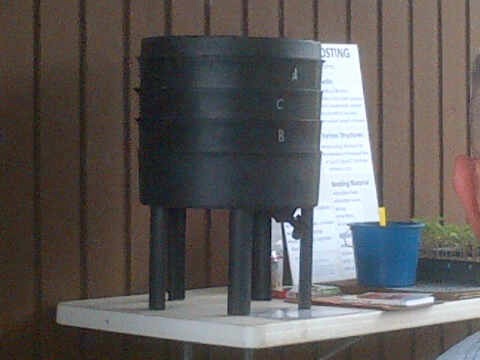
Donald attended an all-day seminar on The Resilient Farmer, Organic Market-Farming for Uncertain Times at the Kerr Center for Sustainable Agriculture (a homework assignment for his Beginning Farmer and Rancher classes) yesterday. He had the opportunity to hear from Dr. Jim Horne, President and CEO of Kerr Center, as well as hear from other experts such as Steve Driver, Agri-Horticulture Consulting (www.agri-synergy.com) and George Kuepper, Horticulture Program Manager, The Kerr Center for Sustainable Agriculture, Inc. (and one of the main instructors for the Beginning Farmer and Rancher classes, www.kerrcenter.com). During this seminar they provided a tour of the Cannon Horticulture Project at Kerr Center (and Donald got an advance peek at what his class will be covering next month), as well as lectures and demonstrations on Organic Matter Management for On-Farm Fertility, Vermicompost (worm composting) and Compost Tea unit demonstrations, Composting Systems, Compost Quality and Usage, Compost Teas and Liquid Compost Extracts, and Using a Soil Test to Develop a Soil Fertility Program.

Information on Vermicompost

Vermicompost Worm Farm

Compost Tea

Interestingly enough, the final recommendation was - if you need compost, it is usually more economical and practical to buy it then make it on the farm. One of the primary advantages of making compost on the farm is to remain as independent from commercial products as possible, a goal of Baker Heritage Farms.

For years, the buzz word in farming has been "sustainable". meaning a method of harvesting or using a resource so that the resource is not depleted or permanently damaged. Dr. Horne explained that maybe we need to update the term to "resilient", meaning capable of withstanding shock without permanent damage and tending to recover from or adjust easily to misfortune or change, all of which apply to farming in todays world. Oklahoma and surrounding states have had their share of "damage" over the past several years, with ice storms, floods, tornados, and drought, and, to be a farmer in this area (as well as many others) one must be resilient. So, our new goal is to be "Resilient Farmers".

Baker Heritage Farms will be preparing for soil testing of the actual garden plots over the next few weeks and hope to have the tests submitted and the results back prior to Donald's class in May, where he will be able to compare them to the plots at the Kerr Center as well as receive guidance on what will need to be done to improve the soil, both short and long-term.

Work is continuing on the Hen house and we still hope to have this project completed in the next week so that we can get the fence up. As soon as the Turkeys are out of the brooder, it will need to be cleaned, sanitized, and prepared for the chickens.

We are building a vendor list and will be adding it to the blog in the near future. While most of the vendors are local, we have used vendors out of the area and will be doing more of this in the near future, so hopefully the list will be useful for everyone. Additionally, we will be providing better cost estimates and time lines, as well as keeping you informed of what we have done right (not sure of this yet) and what we have done wrong (an earlier post will tell you what we did wrong with the Turkey shelter and a future post will tell you what we did wrong with the Hen house).

Until next week,

The Baker Family